

Blog

Demand Side Platforms (DSP)

What is a DSP?

A demand-side platform (DSP) automates the buying of display, video, mobile, and search ads for you. DSPs use algorithms to group all the rates of various networks together on a single platform, and is the control center that allows you to buy media that’s sold programmatically (which is the majority of digital advertising today).

In addition to providing controls to target advertising to specific audiences, a demand-side platform usually employs sophisticated algorithms to automate or augment the targeting so an advertiser can apply budgets more efficiently.

What Targeting Capabilities are Available?

  • Location
  • Age
  • Gender
  • Creative Size
  • Display/Video/CTV
  • Device Type
  • Exchange
  • Contextual Targeting
  • Behavioral Targeting
  • CRM Data
  • Purchase Data
  • Cookies
  • Device Ids
  • IPs
  • etc.

With programmatic, targeting (and retargeting) is more focused. DSPs can target based on several different anonymized factors—demographics, geography, the type of device being used, and browsing behavior, to name a select few.

DSPs also tend to have more advanced performance tracking capabilities that are not possible through traditional ad networks, allowing advertisers to optimize their ad spend more efficiently.

DSPs offer advertisers a way to automate purchases over a huge selection of publishers’ ad inventory. Highly focused targeting combined with the performance tracking capabilities that DSPs offer means advertisers have better control over the quality of the inventory they’re buying. They’re just a small part of the programmatic ecosystem that’s paving the way for better, higher-performing ad technology.

It is important to distinguish that sometimes companies may pose as a DSP, but in reality they may be actually just using another company’s technology. They may have an ad operations team that is pulling the levers on the actual DSP on the backend, or they may have a an API integration to use another company’s DSP.

Example DSPs

  • Rocket Fuel
  • MediaMath
  • Amazon Advertising Platform (AAP)
  • AppNexus
  • Invite Media > Google Doubleclick Bid Manager > Display and Video 360
  • Basis (Centro)
  • Turn
  • Amobee
  • DataXu
  • Brightroll
  • Rubicon Project
  • The Trade Desk
  • Choozle
  • StackAdapt
  • Criteo

In order to determine the advantages and disadvantages of each DSP, G2Crowd has ratings on multiple DSPs from real world users.

https://www.g2crowd.com/categories/demand-side-platform-dsp

In order to further determine the quality of the DSP and to determine which ones would be most effective for you to work with, you can ask some of the questions below:

  • Which supply sources are you integrated with?
  • How many monthly avails do you have? How are these avails broken down in term of:
    • Geography
    • Device Type
    • Product (Display, video, native, etc.)
    • Split between mobile web and app
  • Which of the integrations are direct, and which of the integrations are through ad networks?
  • Do you have an exclusive or pre-negotiated inventory?
  • What is your monthly QPS per territory and what is your maximum QPS?
  • What media buying models do you support? (CPA, CPM, CPC, etc.)
  • Do you offer hyperlocal targeting? (GPS targeting)
  • What level of campaign reporting do you have?
    • How far back does data go?
    • Any limitations?
  • What methods of ad verification and measurement do you have?
  • What is the fee structure for your DSP?
  • Do you assist in setting up campaigns?
    • Is there a fee for this?
  • What training options do you provide?
    • Is there a certification program?

Sources

Ability will never catch up with the demand for it.
— Confucius

avocado-breakfast-delicious-1321942

Trading Desks

What Is an Agency Trading Desk?

ATDs are centralized, service-based organizations that serve as managed service layers, typically on top of a licensed DSP and other audience buying technologies. They manage programmatic, bid-based media and audience buying. They work as an agency’s internal “center of excellence,” supporting agency teams wishing to tap into this new buying model on behalf of agency clients.

Agency trading desks have also been described as:

  • A dynamic way to purchase audiences, allowing media to be purchased in real time rather than from pre-procured inventory.
  • Takes search (an auction based model) and applies it to display media; in a real time fashion like a stock exchange.
  • An audience-buying company.
  • A platform that uses data and technology to help advertisers more effectively purchase audiences at scale across digital media.

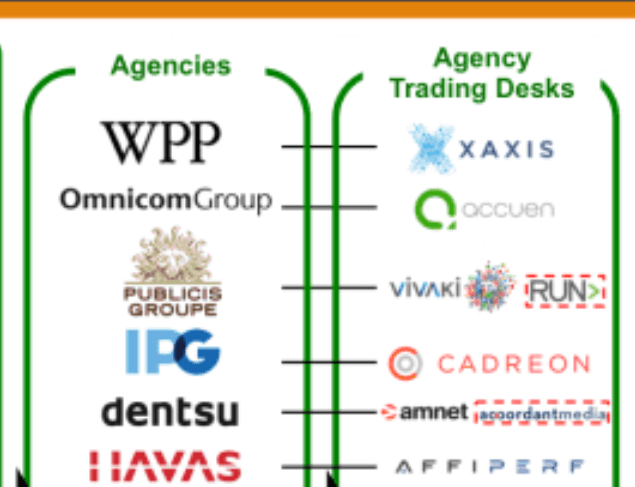
Below is a snapshot of the top 6 holding companies and their respective agency trading desks. Note that Vivaki was disbanded several years back and was recently replaced with Publicis Groupe’s new center of excellence, Precision.

Capture

What Are the Benefits of Working with ATDs?

[ Advertiser → Agency trading desk → DSP → Access to programmatic media ]

Representatives of agency trading desks position themselves as industry specialists. They hire staff with experience, run multiple campaigns for big clients and know how to manage advertising campaigns in various market segments. ATDs use their own data management platforms and ad servers to aggregate audience-based data, analyze it and draw valuable outputs for enhanced performance — a plus for marketers. Another benefit is gaining access to historical bidding data — optimization algorithms, bidding models and response prediction that can be used for repeated campaigns.

ATDs claim to handle every aspect of the marketing campaign so brands don’t need to worry about anything.

  • More precise and better targeting
  • Richer insights about performance on ad spend
  • Better integrations and more consistent service. This holds true for ATDs of major holding companies, such as Xaxis or Cadreon
  • Better ROI due to more precisely targeted ad spend

What Are the Drawbacks of Working with ATDs?

Troubles with agency trading desks first arose in 2012. Since then, a growing number of high-caliber brands have moved media buying in-house to reduce costs, increase transparency and gain more control over budgets. Some ATDs were originally tech enterprises offering unique services, while others simply outsourced most of the technology and paid for the third-party DSPs. In many cases, ATD clients were paying double fees.

Another point of criticism surrounding ATDs is they have a conflict of interest: An ATD is both the seller and the buyer simultaneously; therefore, it cannot be objective. “Trading desks must evolve or face extinction,” according to Digiday UK.

In 2014, an ANA and Forrester survey revealed that 42 percent of client-side marketers reported increased concerns over the levels of transparency between the client and agency. Top issues were media buying effectiveness, performance metrics, viewability, ad serving and billing. Some advertisers were paying up to 80 percent of their budget to the middleman, according to AudienceScience.

  • Lack of transparency
  • Double paying – once to the agency and once again to the trading desk
  • Conflict of interest – ATDs act as the buyer and seller simultaneously
  • Marked up media
  • Mandates by agencies to only use their internal trading desks
  • Operational challenges

Sources

Technology is nothing. What’s important is that you have a faith in people, that they’re basically good and smart, and if you give them tools, they’ll do wonderful things with them.
— Steve Jobs

background-calm-clouds-747964

Advertisers/Agencies

Advertisers and agencies. They are the start of the entire digital ad buying process. The brands want to buy ad space to promote their brand and its products, and in many cases they hire an ad agency to do so.

Advertisers

The very start an impression journey in the long and arduous programmatic chain. the goal of advertisers is to utilize their ad budgets effectively to drive as much of a certain action as possible.

  • Procter & Gamble (P&G)
  • Samsung
  • Nestle
  • Unilever
  • L’Oreal
  • Volkswagen
  • Comcast
  • General Motors
  • Amazon
  • Coca-Cola Company
  • Walmart
  • PepsiCo
  • Johnson and Johnson
  • Target
  • Intel

Top 6 Holding Companies

These large holding companies each contain ad agencies within them.

  • WPP
  • Omnicom Group
  • Publicis Groupe
  • Interpublic
  • Dentsu
  • Havas

Ad Agencies

For our intents and purposes we will be focusing on the agencies that are tasked with media planning and media buying, not media creation. These agencies need to plan where the ads will appear and then negotiate with publishers on a competitive rate.

  • OMD – Omnicom Group
  • Mindshare – WPP
  • Mediacom – WPP
  • Carat – Dentsu (Big presence in Europe)
  • Starcom – Publicis Groupe
  • MEC Global – WPP
  • ZenithOptimedia – Publicis
  • UM – Interpublic
  • Havas Media – Havas
  • Spark Foundry – Publicis Groupe (Previously Mediavest)

Consulting Firms

These days, the role of agencies is being increasing threatened by consulting firms such as Accenture and the Boston Consulting Group. The more the big consultancies move from their current focus on digital technology performance into the brand and advertising space, the greater the threat to marketers and agencies. This [creativity] has been core to the relationship, and having the consulting firms operate here, even under the guise of acquiring agencies, the greater the threat and potential conflict. You are already seeing conflicts between consulting firms and agencies both trying to influence marketers on their choice of ad tech and competing against each other for the big, juicy commissions offered by the large tech firms.

Whereas ad agencies focus on low cpms to drive as many impressions as possible for their ad spend, consulting firms are traditionally performance based. They focus on driving as many actual conversions with as little as spend as possible, and this makes all the difference to advertisers.

  • Accenture
  • Deloitte Touche Consulting
  • Ernst & Young
  • KPMG Consulting
  • PriceWaterhouseCoopers
  • Boston Consulting Group
  • McKinsey & Co.

Sources

Advertising is based on one thing: happiness. And do you know what happiness is? Happiness is the smell of a new car. It’s freedom from fear. It’s a billboard on the side of a road that screams with reassurance that whatever you’re doing is OK. You are OK.

— Don Draper (Jon Hamm)

ball-shaped-blur-blurred-background-1296265

Digital Out of Home (DOOH)

What is Digital Out of Home?

DOOH refers to ads, content, and video showcased outside the home. The message delivery is supported by rich and dynamic digital technology, maximized with real-time capabilities to target consumers on-the-go. DOOH encompasses a variety of screen shapes, sizes, and levels of interactivity. From digital billboards and signs atop taxis, to place-based digital messaging at airport gates, gyms and waiting rooms, DOOH provides a bridge between context and location. It ranks high in relevance and favorable recall—vital components of any media campaign, due to its high level impact and flexibility, relevant to each unique environment, public or private, outside the home.

How can Brands use DOOH?

  1. Transact in real-time: Digital signage can broadcast the halftime score, post happy hour specials, unveil new album art, share tweets, and disseminate emergency broadcasts to keep communities informed.
  2. Be contextually relevant: Localization has always been a core component of outdoor advertising and this has increased trifold with day-parted messaging, traffic monitors, and weather feeds. For example, advertisers can share the pollen count in surrounding areas, offering a value to drivers, and reinforcing their product as a solution.
  3. Integrate personalization: Who doesn’t love seeing their photo on a big screen – especially on a billboard in Times Square? Campaigns that enable consumers to connect with friends and family members, via photos that appeal to our selfie-side, make an instant connection but also offer a valuable keepsake.
  4. Create unique experiences: Transit shelters were once places to pace and text your friends while you waited for your train or bus. Today, a consumer can shop for groceries, play trial video games, and virtually interact with products.
  5. Measure relentlessly: With mobile’s omnipresence, we are now able to track a consumer’s journey and exposure to digital signage and their actions afterwards. Did they visit a store after being exposed to digital signage? Were they more likely to purchase or recommend a product? Location based mobile research (including opt-in mobile surveys), foot traffic studies, and cross-channel attribution is providing additional data to optimize outdoor campaigns.

DOOH Formats

  1. Large Formats are designed and elevated for clear viewing, generally more than 50 feet, and are typically found on highways, high traffic commercial, industrial, and major metropolitan areas. This format delivers high impact exposure and is available in a wide range of markets
  2. Spectaculars are considered high impact units with full motion, often targeting pedestrians in heavy foot traffic areas such as Times Square and Downtown Los Angeles, and also include iconic districts such as Sunset Strip.
  3. Venue Based and Public Spaces typically focus on targeting pedestrian traffic and are commonly found at street level or within a venue. Examples include displays found within municipal properties, health clubs, airports, office buildings, taxi cabs, etc.
  4. Custom Formats complement robust large and small DOOH networks, creating custom opportunities typically used for events and pop-up installations. These formats can range from digital projections, to digital mobile billboards/buses, to empty storefronts that are transformed to create interactive digital experiences using gesture and touchscreen technologies.

Buying Practices

DOOH media is a time-based medium, with pricing largely based on impressions and/or share of voice (SOV). Location can also be used to buy inventory in proximity to a specific point of interest. A typical digital billboard has eight slots in a loop, each 8 to 10 seconds long. Each advertiser receives ⅛ SOV when all of the inventory is sold. To gain a larger SOV, advertisers can buy multiple slots within the same loop. Based on the rating system used for a particular type of digital inventory, the overall estimated impressions will be calculated over a specified period of time (four weeks is common). Rates may be based on a variety of factors including location and demand. Traditionally, out-of-home media plans are created based on four strategic factors location (CBSA/DMA) or proximity to point-of-interest, contextual relevance, network, and demographics (TAB/Nielsen). As new data sets emerge to describe consumers’ physical world behavior, media buyers will be able to utilize advanced behavioral targeting strategies to reach audiences.

Limitations of DOOH

  1. Due to the vast reaching nature of DOOH, you can’t uniquely target everyone. There may be 2 consumers with completely different wants both looking at your DOOH age, but it may be the case that you can only serve a targeted ad to one of them. This is a limitation that was not previously an issue with standard digital ads on mobile, desktop, etc as there was usually only one set of eyeballs on those.
  2. In order to tailor the ads to the consumer, more dots need to be connected. With ads on mobile or desktop, consumers can be matched to cookies or their device ids and they would be served a targeted ad on the same browser or device that they were using. With DOOH, a visitor may not be using a device at all. The machine showing the DOOH ad must be able to somehow connect the dots to find what person is viewing the ad through wi-fi scraping, location information via a mobile app, or some other identification method.
  3. Limited amount of screens. Because DOOH screens are so large and only in public areas, there are much fewer DOOH screens than standard screens. This is one of the reasons why buying DOOH is a lot more costly than buying standard programmatic media.

A Glance at DOOH Providers and Delivery Formats

Capture

Sources

Many a small thing has been made large by the right kind of advertising.
— Mark Twain

beach-dawn-dusk-1144176

Ad Tech Ecosystem

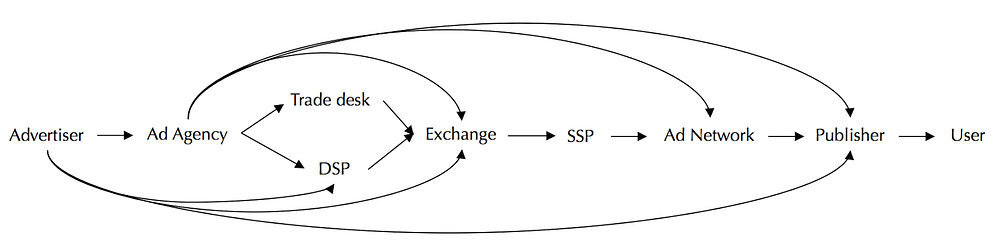
In the early days of advertising, all an advertiser did was advertise its brand to a user. This could happen through billboards, posters, tv, radio, etc. Advertisers will always be interested in promoting their products and services to users. As the internet and digital media became more and more popular, traditional mediums of advertising such as TV and magazines were getting left behind. Digital media has become a powerhouse in reaching potential customers, and is still growing to this day. However, digital media has brought in an entire web of complexity with its arrival that is the ad tech ecosystem. In the ad tech ecosystem, there are many steps to for an advertiser to reach the end user. Along these steps, there can be a slew of bad actors, fee markups, and implementation errors. Below is an illustration of the steps an potential impression can take before it reaches the user.

Advertiser

These are the brands that are promoting their products and services. All they want to do is to get their message across to the user.

Ad Agency

Ad agencies manage the planning, buying, and placement of ads for brands. They usually charge a fee for this service, whether it be a percentage fee or a fixed amount. Sometimes ad agencies will outsource the creative creation to a creative agency, whereas sometimes this will be done in house.

Data Management Platform (DMP)

DMPs are used to house both first and third party data in an anonymous fashion. Agencies/DSPs tap into DMPs in order to make powerful data driven decisions when it comes to planning and buying ad inventory.

Trade Desk

Larger agencies will usually have a trade desk. Trade desks are the digital trading arms of these agencies, and they specialize in both buying digital media inventory and tracking the performance of bought inventory.

Demand Side Platform (DSP)

A real time buying and bidding engine that makes calculated bids and buys on behalf of the advertiser/agency. Make decisions such as how much to bid, when to bid, and what users to target.

Ad Servers

Ad servers store the ad creatives and will serve the requested ad creative in the requested publisher slot at the requested time. Ad servers plug into DSPs and sometimes ad networks.

Ad Exchange

Ad exchanges can be considered as large boiling pots of inventory and buyers, where buyers and sellers can conduct split second decisions on buying and selling inventory.

Supply Side Platform (SSP)

The DSP equivalent for publishers. SSPs aggregate publisher inventory and sell it to the highest bidders in order to maximize revenue for publishers.

Ad Networks

Ad networks aggregate unsold inventory from publishers and typically resell it to SSPs or in ad exchanges. Ad networks are slowly falling out of favor as they generally sell the same inventory at a markup.

Publishers

Publishers are the owners of ad space, the content creators. Any website, blog, or area of the web which generates visitors can be considered a publisher. They have advertising space on their websites, and they want to cash in by selling ad space to advertisers.

Although this is a traditional path from advertiser to publisher, there can be many others. The only constant is that the path will always start with the advertiser and end with the publisher. Publishers can sell direct to advertisers/agencies, advertisers can utilize DSPs directly without the help of an agency, and advertisers can even go straight to an ad exchange.

Because the industry is so fragmented and there are so many layers, only around 40% of the advertiser ad spend actually goes to the publisher. Each layer is taking their own share of the sale, and the publisher is left with less than half of what was intended for them.

In a fragmented industry, it’s important to understand what each layer of ad tech does and how they interact with one another.

Sources

I have a lot of plants and fish and a pet lizard and Venus flytraps. I have a whole ecosystem in my room, like a running waterfall and different lights and sensors set on digital timers.
— Chris Pratt

bike-broken-city-1045535