
Blog

Ad Fraud

Billions of advertising dollars are lost each year due to ad fraud. Because programmatic advertising is open to publishers and advertisers of all sizes with little requirements to entry, it is easy for bad actors to join the fray and damage the ad tech ecosystem. Various industry reports have claimed that ad fraud can account for 40-60% of all ad tech traffic. Ad fraud is a serious problem that is plaguing our industry. The good news is that we are taking steps to fight against it.

What constitutes ad fraud?

An ad is considered fraudulent if it has one or more of the following characteristics:

  • Nonhuman traffic (bots)
  • Zero chance of being seen
  • Intentional misrepresentation

Essentially, an ad is fraudulent if the sole purpose of it being there is to generate revenue with no intent of ever being visible to the user.

What are the different types of ad fraud?

This can be broken down into two separate sections – human fraud and nonhuman fraud. Although the industry generally refers to nonhuman fraud, human fraud is also a large concern that must be addressed.

Nonhuman Fraud

  • Simple bots. These are simple bots that run from another server. They generally have a static ip and user agent, and are easy to block.
  • Sophisticated bots. These bots are a lot harder to track as they mimic normal human mouse behavior as well as CTRs. On top of that, they switch ip addresses and user agents from time to time.
  • Botnets. The fraudster can overtake many unsuspecting users’ computers and run the bot program in the background. Because the fraudster generally infects many computers through a botnet and uses very little processing power for each one, it’s very common that the infected users never even become aware of this.
  • DOS Attacks. AKA denial of service attacks. Fraudsters can also infiltrate websites by overloading the servers with so many bots that the servers fail.
  • Ghost Sites. Fraudsters falsely produce or steal websites from legitimate content creators. They then can utilize bot traffic to monetize these fake sites.

Human Fraud

  • Pixel Stuffing (Iframe Stuffing). A 1×1 pixel is placed on a site that the user visits. An advertisement is loaded through the pixel but the user does not see anything. The seller will still generate revenue from this.
  • Ad Stacking. One or more ads is hidden behind the first ad. Imagine a publisher ad slot for a 300×250 creative that has 2 other 300×250 creatives loaded right behind them. The publisher generates revenue for all 3 creatives, but the user can only see the first creative.
  • Domain Spoofing. The fraudster can fake a no-name domain so that it looks to the buyer that it is a premium domain, such as businessinsider.com.
  • Arbitrage. Shady publishers can purchase shady traffic to their websites and monetize for a profit. At a low enough purchase price, one can be almost sure that the purchased traffic is comprised of bots. The publishers then can go around and monetize this traffic at a higher cpm compared to what they bought it at.
  • SDK Overlap. SDKs are not designed to work together. If multiple SDKs are used in one mobile app, it could be the case that multiple impressions are delivered but only one is viewable by the user.
  • Click Farms. Real life people are paid to work from home and create meaningless clicks, conversions, etc.
  • Cookie Stuffing. An affiliate marketing scam where the user makes a purchase and the hidden cookie allows the fraudster to receive a commission for “helping” to generate the sale.

Why is ad fraud so rampant?

  • Ad fraud is technically not illegal. For someone that knows what they’re doing, ad fraud is a much more attractive way to make money that another form of crooked behavior, such as stealing from a store. Whereas stealing from a store is high risk, medium reward, ad fraud is low risk and high reward. It is a white collar crime that does not yet have the proper penalties assigned to it.
  • There are low barriers to entry. It is very easy for any publisher or buyer to conduct a transaction through the programmatic marketplace.
  • The ad tech model rewards volume, not performance. Because so many partners in the ad tech chain receive a percentage cut of the total ad spend, these partners are incentivized to generate as much activity as possible with not as much of a focus on performance.

According to ad fraud prevention company pixelate, ad fraud ran most rampant in the OTT/ Connected TV category.

What can our industry do about ad fraud?

  • Publishers can ensure that ads are served to real humans by monitoring traffic sources.
  • Suppliers can vet all publishers on their platforms.
  • Ad-buying platforms can proactively monitor and block low-quality inventory.
  • Marketers can utilize their own tools and 3rd party partners for ad safety.

How can you protect yourself against ad fraud?

  • Utilize pre-bid segments
  • Use an ad verification partner
  • Monitor reporting closely
  • Maintain and grow a whitelist or blacklist based on performance
  • Utilize PMPs as they are much less likely to contain ad fraud.

Sources

The reason we love our parents is because they loved us first. Every single company should take this advice.
— Gary Vaynerchuk


africa-animals-black-and-white-3158

Viewability

If a tree falls and makes a sound in the middle of the forest but no one hears it, does it still make a sound?

This is a similar example to ad tech an impression may be delivered, but there may be no one that actually sees the ad. Advertisers and brands want to ensure that the ads they serve are actually seen by a user. To them, every dollar that is spent serving an unseen ad is a dollar wasted.

As one of the many tactics that buyers of media use to measure how effective their ad buys are, viewability measuring is a staple in our industry.

How is Viewability Measured?

The MRC states that an display ad is viewable if at least 50% of the pixels are in-view for at least 1 second. For video ads, 50% of the pixels must be in-view for at least 2 seconds.

The IAB follows these exact same guidelines, except they count larger sizes such as the 970×250 and 300×1050 as viewable if 30% of the pixels are in-view for at least 1 second.

Key Viewability Terms

  • Measured Impressions (the number of impressions that the viewability partner was able to measure)
  • Viewable Impressions (the number of impressions that the viewability partner measured as viewable)
  • Total Impressions (the total number of impressions that were served)

Viewability Rate = Viewable Impressions/Measured Impressions * 1,000

Note that some of the impressions are unable to be measured due to technology limitations, but so the viewability rate is actual based on the portion of the inventory that was measurable.

Industry Viewability Standards According to IAB

54.7% of desktop display ads are in-view.

66.3% of desktop video ads are in-view.

46.5% desktop VCR

49.0% of mobile web display ads are in-view

57.6% of mobile app display ads are in-view

70.3% of mobile web video ads are in-view

41.4% mobile web VCR

Publishers vs Advertisers

By measuring viewability on ads served, advertisers are paying a premium to ensure that their ad quality is up to par. If the viewability metrics are lower than their expectations, advertisers can then bring this up to the publishers. This essentially brings up an extra layer of responsibility on the publisher’s behalf.

Within the purchase agreement, the buyer can add a viewability guarantee as one of the requirements of the publisher. The publisher can charge a premium for this, but they will be required to maintain a minimum viewability.

Causes of Poor Viewability

  1. The user has enabled ad blocking software. Ad blockers are browser plugins or filters that hide or disable ads from loading. When the page loads, the ad blocker identifies ad slots and hides ad creatives, leaving these placements blank. For the end user, it seems like there is nothing there, but for the network, the ad is served, therefore it counts as an impression.
  2. Non-human or bot traffic. Created by humans, bots are the programs that visit various websites and imitate human behavior: they scroll, click, refresh the feed, and engage with the content in a way a real user would. Ad networks cannot detect bot traffic, so they count every bot-generated impression as a successful one.
  3. The user leaves a web page before the ad loads. 40% of people abandon a website if it takes more than 3 seconds to load. Many users open multiple tabs at the same time and browse through other programs while the ad loads and renders. The most common case is when the user quits the page and the session is torn down, but the impression is still counted.
  4. Requests made by web crawlers, spiders, download managers, web-directories, link checkers, web filtering tools and other non-human technologies load the web page and generate ad impressions that are served successfully, but never get exposed to the human eye.
  5. Location of the ads. Some of the ads are located in the “down the fold” or “scrolling” position or do not fit into the window dimension, therefore cannot be spotted by the user.
  6. Ad stacking and pixel stuffing. When multiple ads are placed on the top of one another, with only the top one visible to the user, but impressions are reported for all layered ads. With pixel stuffing, a 1×1 pixel is placed on the site that loads as an ad creative but still not visible to the user. Such practices are fraudulent and illegal, but still take place in digital advertising.

Precautions and Other Thoughts

The goal of viewability is to ensure that advertiser budgets are actually being spent on influencing the viewer. Although it is a good standard and benchmark, these are some considerations to follow.

  • A user can still be influenced by an ad that is 45% viewable.
  • For videos with automatic sound on, a user can be influenced by merely the sound of the ad even if it is not viewable at all.
  • How will ad measurement companies measure viewability for programmatic audio? Digital out of home?
  • An ad may be 100% viewable, but the user may have wandered off elsewhere, away from the screen

Viewability Measurement Providers

  • Integral Ad Science (IAS)
  • DoubleVerify (DV)
  • Moat
  • Pixalate

Sources

The problem is you can’t spend enough to acquire a customer, and the way to fix that problem is to fix your sales funnel.

— Russell Brunson

cool-wallpaper-dawn-dusk-66997

Rich Media

What Are Rich Media Ads?

Rich Media Ads allow for more interactivity and motion as compared to a standard banner ad with a still image. They may appear in ad formats such as banners and buttons, as well as interstitials and various over the- page units such as floating ads, entire page take-overs, and tear-backs.

Rich Media refers to the utilization of various technologies to enhance a recipient’s experience. It uses advanced technology such as video streaming to interact instantly with the user. All the rich media technologies generally exhibit at least some of the following characteristics:

  • Allow for advanced animations,
  • Support audio/radio in the advertising’s,
  • Instant user interactions, etc.

Essentially, rich media is identified by the media element exhibiting dynamic motion and this motion can occur over time or in response to an interaction with the user too.

Standard creative Rich media creative
  • A single .html, .gif, .png, or .jpg file format of 200K or less
  • Contains no video or expansion
  • Usually only tracks a single click-through link
  • Usually exceeds 200K
  • May use multiple files
  • May contain video
  • May expand to a larger size
  • May include detailed tracking metrics on user interactivity
  • May track multiple click-through links
  • May contain other special features (polling, send-to-a-friend, gallery, etc.)
  • Some publishers may require a polite load (allowing a publisher’s page content to fully load before the creative starts loading)

Types of Rich Media Ads

There are many different types of rich media creatives. These can overlap with each other as well as the standard creatives.

  • Banner. A creative with a fixed size and position on a web page or in a mobile app. The most basic rich media ad format.
  • Interstitial. A creative that either floats on top of a page’s content or appears as a fullscreen ad during natural transition points in mobile apps, such as during launch, loading, and video pre-roll. Interstitial creatives served on web pages can move with content or maintain a locked position as a user scrolls. The “Locked” option is enabled at the trafficking stage.
  • Banner with Floating. A banner creative displayed at the same time as an interstitial.
  • Expanding. Expansion can take place after a user interacts (for example, by click, tap, or mouse-over) or automatically when the page loads (auto-expand). Creatives can expand in any direction, shape, or with fading effects and can collapse on user interaction, automatically on mouse-out, or based on a timer. Other expanding creative types include: Lightbox, multi-directional expanding, and push-down.
  • Multi-Directional Expanding (MDE). A creative that expands in multiple directions, depending on where the ad appears in the page. For example, when the ad is on the left side of the page, it will automatically detect its location and expand to the right. If the same ad is served on the right side of the page, it will expand to the left.
  • Dynamic. Banner, expanding, interstitial, or VPAID creative types can also be dynamic. Dynamic creatives use a linked management profile that can change creative content on the fly, either manually or based on content rules.
  • Push Down. An expanding creative that pushes down the content of a webpage when the creative expands, moving the web page out of the way to display the ad. If the push-down is frequency capped (a user can only see it auto-expand a certain number of times during a given period), then you must build both a user-initiated expanding version and an auto-expanding version. You must also select a setting for this option in the trafficking stage.
  • Video. Standard VAST video creative.
  • Video Player-Ad Interface Definition (VPAID). VPAID videos can pause a publisher’s content and play the creative, such as a mid-roll ad. They provide more interactivity options than typical VAST video formats. The user can click into them and interact, expand, or maneuver about the VPAID player. Allows developers of rich media to utilize a common language. Without this, the same creative may need to be reformatted for different publishers and apps.
  • Mobile Rich Media Ad Interface Definition (MRAID). Similar to VPAID creatives in that it provides a common format for creative developers to write a creative. It also serves as the framework for interactive creatives in mobile app, but not mobile web.

Features of Rich Media Creatives

  • Sound
    • Auto sound on
    • Hover for sound
    • Click for sound
    • Sound on after some time has elapsed
  • Expanding
    • Expands from up, down, left, right
    • Expands on click
    • Expands on hover
    • Expands after some time has elapsed
  • Effects
    • Fading
    • Pop up
    • Stick to page
  • Interactivity
    • 360 VR experience in ad
    • Survey in ad
    • Game in ad
  • Landing Page
    • Click to web page
    • Click to app
    • Click to call
    • Click to map

Rich Media Providers 

  • Celtra
  • Contobox
  • DoubleClick Studio (Display and video 360)
    • Part of the full stack Google ad tech solution
  • InMobi
    • Also an Ad Exchange
  • Sizmek (Acquired PointRoll)
    • Also an Ad Server

Sources

It is the supreme art of the teacher to awaken joy in creative expression and knowledge.
— Albert Einstein

android-wallpaper-art-backlit-1114897

Location Targeting

What is Location Targeting?

Location targeting is the act of tailoring ad targeting to the user depending on the user location.  It is just one of many tactics advertisers/agencies can use to create relevant and effective ads and target them towards consumers at the right time.

What Methods do Advertisers use to Determine a User’s Location?

Advertisers can determine a user’s location through the user’s wifi, ip address, or their lat/long location. On the mobile front, marketers can track these by by tapping into the user’s apps. Depending on whether or not the user has the app running in the background and if location tracking is enabled, the app may be able to pass along the device’s GPS coordinates to the marketer. Lastly, beacons can also be used to broadcast a device’s location through bluetooth over a short distance. If an app has a particular sdk registered to it, it can register that the device was at a certain location.

What Types of Location Targeting is there?

  • Current vs historical targeting
    • Marketers can choose between targeting current locations vs historical locations. Current locations refer to where the user is at the same moment in the time when the ad is served. Historical data refers to where the user has been in the past. For example, a car brand may decide to target users who have been to a car dealership in the US within the last 60 days.
  • Political Boundaries
    • Countries
    • States
    • Designated Market Area (DMA)
    • Cities
    • Counties
    • Postal Codes
  • Hyperlocal Targeting (GPS Coordinates/Latitude and Longitude)
    • This is typically referred to as “geo-fencing”, where a certain GPS coordinate is chosen and given a radius. The chosen GPS coordinate would then be given a “fence” with the radius size. Any user who walks into this circle, assuming they are somehow able to give off their GPS coordinates, are susceptible to being targeted by the marketer. Hyperlocal targeting can be applied to both current and historical targeting.
  • Stores and Places
    • Any notable places such as McDonald’s, Kmart, Central Park in NYC, can all be targeted as well. Both the current and historical targeting methods are applicable for these places as well. Depending on the location partner, some places may or may not be available.

What are some Relevant Strategies for Location Targeting?

  • Target languages to fit the target audience. In a spanish speaking area in the US, it may make sense to serve spanish creatives to users who can be tracked with location targeting.
  • Experient with currency signs depending on where the ad is served.
  • Serve ads that are relevant to local consumers.
  • Test visual elements that may be appealing to consumers in a certain location.
    • Appealing to the culture of a user in a certain country.
    • Appealing to the interest of a user in a certain hobby store.
Geo-targeting Geofencing Beaconing
Best used to reach users who: live or move about in a certain area, for whom you have other data like preferences or demographic info Best used to find users who: are nearby your store, venue, or service; users who are in your parking lot, or entering a mall, for example  Best used to reach users who: are in a certain aisle of your store; who are on a certain bus or train; who are moving through a space like a museum
Users within a broad general range (within a zip code, for example) Captures users within a 50 meter or so range  Captures users in a specific location or range (can determine almost to the inch of where you’re standing)
Can incorporate other preferences to narrow users down for greater specificity Is more of a blunt object: other user preferences cannot be paired  Other user preferences cannot be incorporated
Relies most heavily on IP address Relies most heavily on GPS (and WiFi, to some degree) Relies most heavily on bluetooth technology
Location accuracy is not as important when using geo-targeting, as other preferences refine your segment
Ex: Only people [in this town] who are [women], [over 50], who like [healthy stuff].
Offers some accuracy, though will likely capture users who are just passing through an area, in addition to folks who have come to a location purposefully (can be a plus or a minus, depending on your campaign)
Ex: All of the people who walk by your organic health bar
Beacons are highly specific, to the point that they can tell when users in a retail space go upstairs or downstairs or enter a certain aisle
Ex: Anyone in your organic health bar who lingers in front of the matcha for 10 seconds or more.

What are some Location Targeting Providers?

  • Factual
  • Placed
  • NinthDecimal
  • Grountruth

How can we Evaluate Location Targeting Providers?

  • How does the provider define location?
  • How do you prevent misleading and fraudulent data?
  • How are exposed visits calculated and measured?
  • How does media planning and placement affect measurement?

Sources

You’re only given a little spark of madness. You mustn’t lose it.
— Robin Williams

apple-caffeine-coffee-597330

Measurement and Attribution

In an already complex web of countless ad tech players in a long programmatic chain, ad measurement and attribution partners are thrown into the fray. Although they introduce another level of complexity, they are necessary for advertisers/publishers to ensure that quality ads are served. There are many aspects about ad placement that can be measured, including but not limited to viewability, brand safety, and fraud. Brands want to ensure that their ad spend is being used in an effective manner and they turn to the ad measurement/attribution partners to do so.

Ad Measurement Partners

These partners measure the performance of the ad. It measures things like fraud, brand safety, viewability, etc.

  • Integral Ad Science (IAS)
  • Doubleverify (DV)
  • MOAT

Multi Touch Attribution (MTA)

MTA calculates the effectiveness of each ad in getting the user to make a purchase, and it weights each point (touch) in the ad exposure process to how important it was in procuring the sale. For example, imagine you have been shown an ad for a particular shoe available at Foot Locker. You then browse the Foot Locker site but don’t buy right then. You are then shown another ad later, this time containing a coupon, and you decide to make the purchase. After you make the purchase, the ad attribution partners would determine how important each ad was in getting you to buy the shoes.

Other Attribution Models (Not as effective)

First Touch

100%>0>0>0

The first ad exposure gets 100% of the credit. This completely ignores all later points in the ad exposure chain and is not effective.

Last Touch

0>0>0>100%

The last ad exposure gets 100% of the credit. This completely ignores all earlier points in the ad exposure chain and is not effective.

Linear

25%>25%>25%>25%

All ad exposures get an equal amount of credit. Although this simplifies attribution, it is the most accurate as mostly likely one part of the ad exposure chain was more effective than another.

Time Decay

5%>20%>25%>50%

The closer an ad exposure is to the purchase time the more credit that it receives. This is a more accurate estimation as consumers are more likely to respond to more recent ads.

Ad Attribution Partners

Ad attribution partners can typically match to the DMP at the tag/pixel level. This usually happens via a cookie sync with the attribution partner’s tag.

  • Adjust
  • Adways
  • AppsFlyer
  • CyberZ
  • Kochava
  • Singular
  • Tune

Malicious Ads/Malware Security

  • GeoEdge
  • TheMediaTrust

Ad Quality Standards Associations

These associations present best practices and benchmarks around quality for the industry to refer to.

  • Interactive Advertising Bureau (IAB)
  • Media Rating Council (MRC)

Ad Tech Benchmarks

MRC In-View Requirements (For both desktop and mobile)

  • 50% of display ad pixels are in view for at least 1 second
  • 50% of video ad pixels are in view for at least 2 seconds

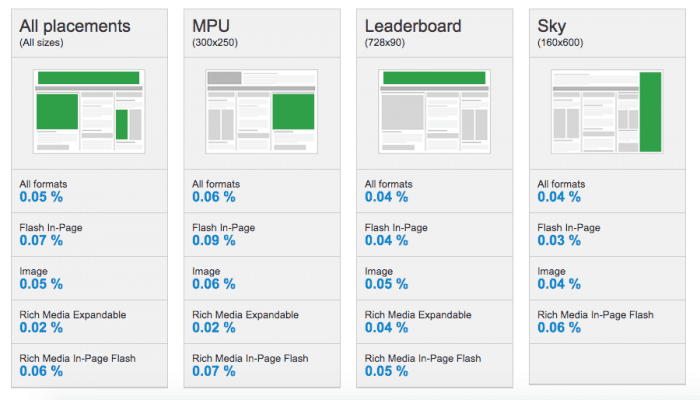
CTR Benchmarks for Display Ads

Viewability Benchmarks for Display Ads

Capture

Video Benchmarks

  • Average VCR: 81% (on all video impressions)
  • Average CTR: 0.26%
  • Average Time Spent
    • 12s on 15s video ads
    • 25s on 30s video ads
  • 62% viewability
  • Invalid Traffic Rate (IVT): 3.7%

Sources

I value an entrepreneur I can get behind and trust, because I know they are attempting to move forward in life.
— Daymond John

architecture-big-apple-buildings-1388069