


At the turn of the next decade in December 2019, there are 3 major header bidding wrappers that are prevalent in today’s programmatic environment: Prebid, Amazon Transparent Ad Marketplace (TAM), and Google Open Bidding (previously Google Exchange Bidding). Other header bidding wrappers such as those of Media.net and Index Exchange exist, but these are the 3 wrappers that dominate the market today.
Prebid.js
The major draw to Prebid is that it is a financially free and transparent open-source tool that anyone can use. In fact, the Prebid source code is openly available on Github. At the time of this post, the latest version of Prebid is 2.43.
https://github.com/prebid/Prebid.js/releases
The table below from Prebid.org notes some of the latest releases in reverse chronological order. One aspect of their release numbers I’ve noticed is that the release versions follow a strictly numeric order. For example, version 2.20 is newer than version 2.4.
| Release | Feature |
|---|---|
| 2.20 | AuctionEnd event now always execute when auction completes even when there’s no callback handler |
| 2.18 | Currency Module: always adding originalCpm and originalCurrency to bid object |
| 2.17 | Ability to limit the size of keys sent to ad server via targeting controls |
| 2.16 | User ID module refactored to support external sub-modules |
| 2.10 | User ID module released with support for PubCommon ID and Unified ID |
| 2.10 | A bidder which responded in time is now considered a timely bidder, even if it responded with no bids. See PR 3696 |
| 2.9 | Add ‘hb_cache_host’ targeting for video bids when cache is set to support upcoming video cache redirector |
| 2.9 | remove removeRequestId logic. See PR 3698 |
| 2.8 | Added s2sConfig syncUrlModifier option to modify userSync URLs |
| 2.8 | Add hb_uuid and hb_cache_id back to dfp module after having been removed in 2.7 |
| 2.6 | Update auction algorithm logic for long-form. See PR 3625 |
| 2.6 | In case Prebid.js is called from within an iFrame, matchMedia is applied to window.top, not the containing iFrame. |
| 2.5 | Fix event firing on native click. See PR 3589 |
| 2.4 | Long Form video |
| 2.4 | Bug fix for hb_uuid/hb_cache_id. See PR 3568 |
| 2.3 | Bug fix for Firefox for some ads that use document.write See PR 3524 |
| 2.1 | Refined the bid.adId and bidRequest.bidId. See PR 3340 |
| 2.0 | The limited bid caching feature now turned off by default. |
| 1.39 | The limited bid caching feature can be optionally turned off. |
| 1.39 | Bug fix in the currency module introduced with 1.37 where it wasn’t calling for the currency conversion file when defaultRates are specified. |
| 1.37 | The default location of the currency conversion file changed. |
| 1.36 | New NO_BID event makes a “no bids” response available to analytics adapters. |
| 1.34 | User-sync iframes are now inserted at the bottom of the head element, rather than at the top. |
| 1.30 | Bugfix to Auction Init events. The timestamp had been removed in 1.28 and caused issues in some Analytics Adapters. |
| 1.27 | Render outstream safeframe with prebid universal creative. |
In addition, publishers with more complex ad stack setups are free to optimize more freely with Prebid as compared to other solutions such as Index Exchange or Google Open Bidding.
One downside to Prebid is the operational complexity involved with setup. The operational complexity usually involves heavy engineering resources and time in order to complete a Prebid setup. Because of this, companies such as Rubicon and Pubmatic have started to offer managed Prebid services where there is a fee charged for helping publishers set up and manage their Prebid.js instances.
According to Prebid.org, at a high level there are only 4 steps to running a Prebid auction.
- The ad server’s tag on page is paused, bound by a timer, while the Prebid.js library fetches bids and creatives from various SSPs & exchanges you want to work with.
- Prebid.js passes information about those bids (including price) to the ad server’s tag on page, which passes it to the ad server as query string parameters.
- The ad server has line items targeting those bid parameters.
- If the ad server decides Prebid wins, the ad server returns a signal to Prebid.js telling the library to write the winning creative to the page. All finished!

Google Open Bidding (Previously Google Exchange Bidding)
The more substantial benefits for publishers when adopting Google Open Bidding include much less operational complexity and a much faster page load time due to it being a server-to-server connection.
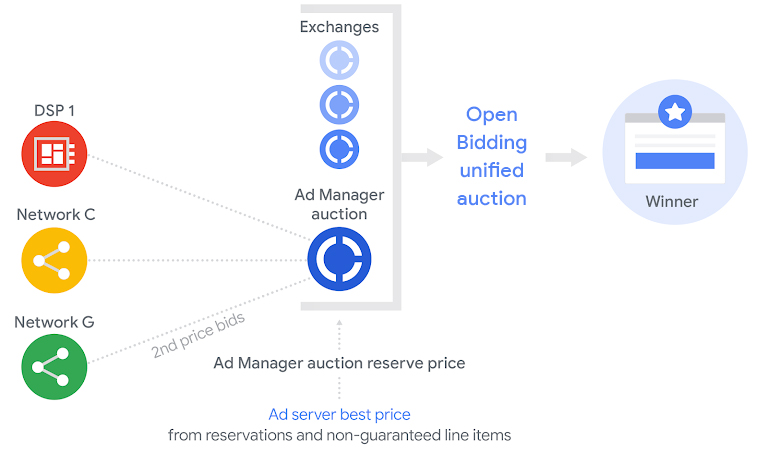
According to admanager.google.com, there are only 3 steps for the Google Open Bidding Solution.
- An ad request is triggered
Requests are sent to the Ad Manager server using Google Publisher Tags, the Google Mobile Ads SDK, or the IMA SDK. Support for native inventory is not yet available. - Ad Manager hosts a unified auction to determine the highest eligible bid
Ad Manager requests bids from eligible Authorized Buyers, third-party exchanges, and/or mediation networks, through targeted yield groups, which return their highest bids to Ad Manager. These bids then compete with all of your reserved and non-reserved line items in a unified first price auction, and the highest bid wins. - The winning creative is returned to the publisher
After a winner is selected, the ad server returns the winning asset or mediation list to the publisher for display.
- Dramatically minimized latency:
With direct server-to-server connection to third-party exchanges and an extended auction time of 160ms (up from the Ad Exchange requirement of 100ms), Open Bidding reduces latency (when compared to header bidding implementations) for a more seamless user experience. - Reduced operational complexity:
Open Bidding eliminates the need to manage complex custom header bidding code and the numerous Ad Manager line-items associated with a header bidding implementation. Eligible inventory trafficked in Ad Manager can benefit from Open Bidding with no additional technical development required. - Increased transparency and unified payments:
Understand the exact revenue you’re earning from each exchange with unified and accurate reporting. Get paid faster (net 30 days) and bill more accurately, without the 5-10% discrepancies common today — since serving, billing, and reporting are all on a single stack. - Improved reporting and analytics:
A unified reporting interface provides valuable advertiser and brand information, with improved query tool reports that cut across sales channels. The reports provide clarity on the value each partner brings and help you identify, report on, and analyze the advertisers and brands who bought impressions that were filled through Ad Exchange and Open Bidding.
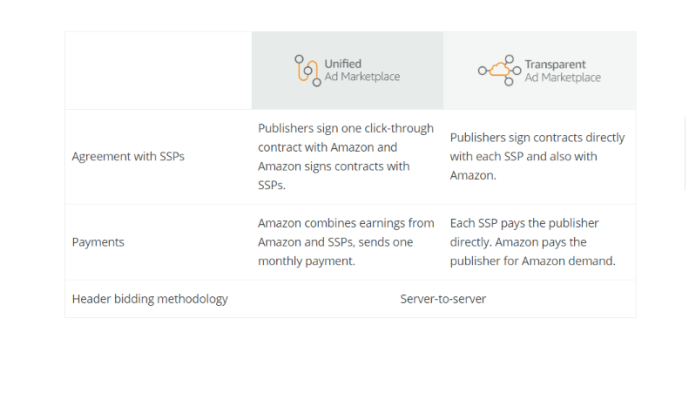
Amazon Transparent Ad Marketplace (TAM) vs Amazon Unified Ad Marketplace (UAM)
Below is a comparison of TAM vs UAM according to aps.amazon.com. TAM is dedicated for enterprise publishers whereas UAM is meant for smaller publishers.
Comprehensive Comparison of Top Wrapper Features
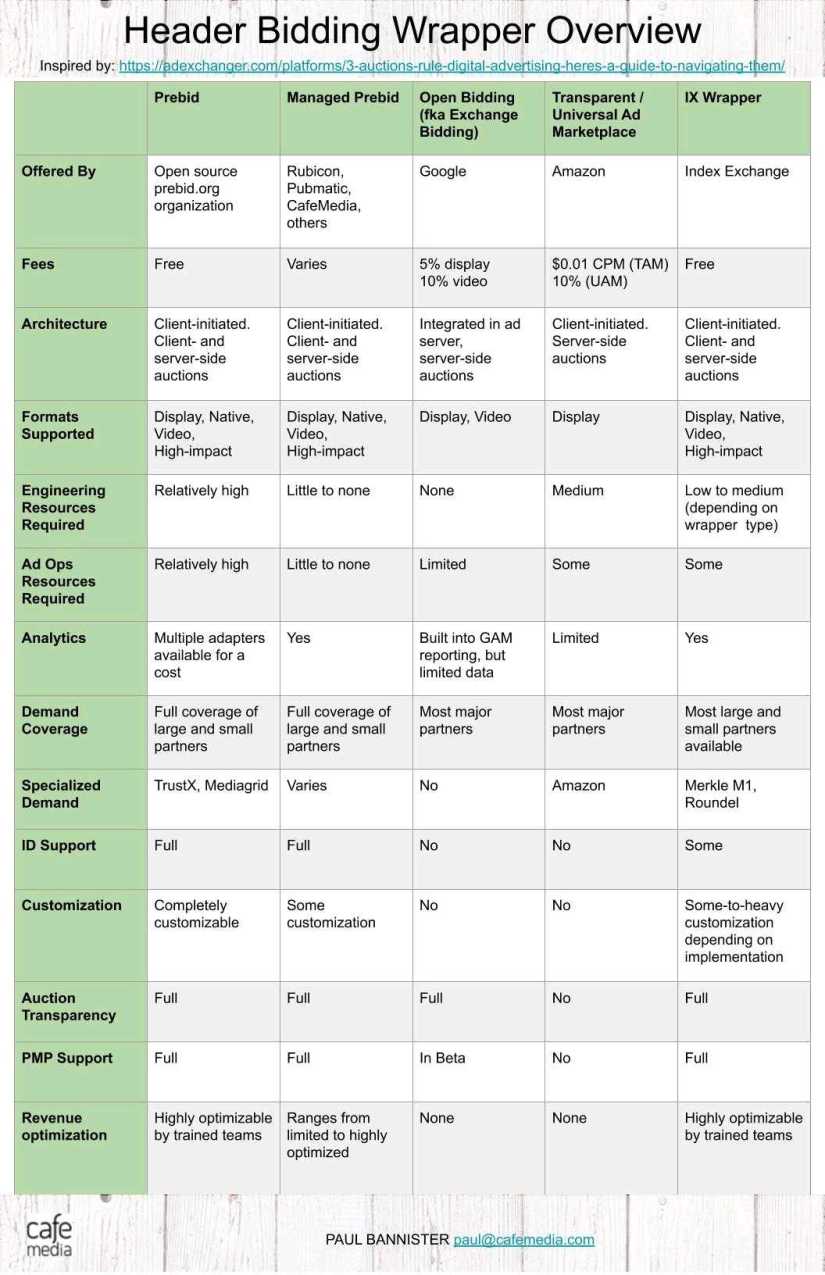
Paul Bannister of Cafe Media has created a fantastic header bidding wrapper comparison of the top 5 wrapper solutions, which breaks down how each stacks up to one another in 14 different areas of comparison.
Sources
- https://adexchanger.com/platforms/3-auctions-rule-digital-advertising-heres-a-guide-to-navigating-them/
- Paul Bannister – Header Bidding Wrapper Overview on LinkedIn
- https://prebid.org/
- https://www.indexexchange.com/debuting-the-ix-wrapper-ecosystem/
- https://admanager.google.com/home/resources/feature-brief-open-bidding/
Whoever is happy will make others happy too.
— Anne Frank


 Simply Ad Tech