


What is the Federal Trade Commission (FTC)?
The Federal Trade Commission is a federal entity that is meant to encourage fair trade practices. According to the FTC website, the main strategic goals of the FTC are:
- Protect consumers from unfair and deceptive practices in the marketplace
- Maintain competition to promote a marketplace free from anticompetitive mergers, business practices, or public policy outcomes
- Advance the FTC’s performance through excellence in managing resources, human capital, and information technology
The FTC is meant to protect consumer interests by preventing trusts, consumer manipulation, and other predatory practices.
FTC Divisions
The FTC has 8 divisions, each responsible for a specific aspect of business:
We will be focusing on the Division of Advertising Practices, which encompasses digital media.
FTC Division of Advertising Practices
FTC enforcement priorities include:
- combating deceptive advertising of fraudulent cure-all claims for dietary supplements and weight loss products
- monitoring and stopping deceptive Internet marketing practices that develop in response to public health issues
- monitoring and developing effective enforcement strategies for new advertising techniques and media, such as word-of-mouth marketing;
- monitoring and reporting on the advertising of food to children, including the impact of practices by food companies and the media on childhood obesity;
- monitoring and reporting on industry practices regarding the marketing of violent movies, music, and electronic games to children;
- monitoring and reporting on alcohol and tobacco marketing practices.
As we can see here, the FTC is meant to prevent and punish many types of deceptive or dangerous marketing behaviors In addition, it is extra sensitive of marketing to children. It aims to protect sensitive consumer information, prevent predatory advertising, and also prevent consumers from getting spammed with advertising.
Google and Facebook, previous FTC Fines
FTC and NY Attorney General vs Google and Youtube
According to the FTC:
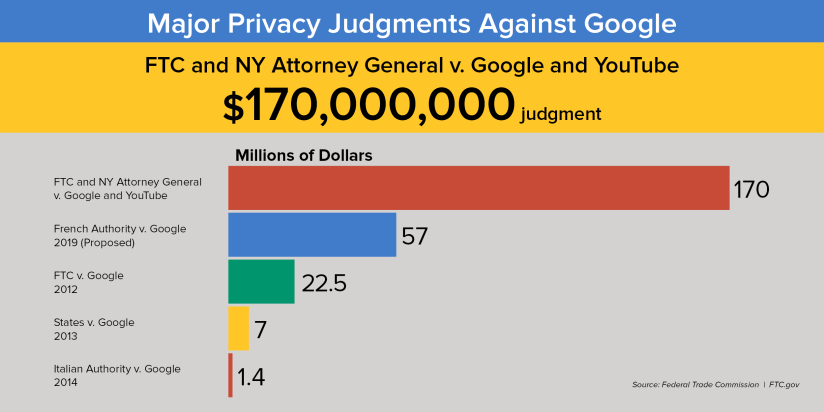
Google LLC and its subsidiary YouTube, LLC will pay a record $170 million to settle allegations by the Federal Trade Commission and the New York Attorney General that the YouTube video sharing service illegally collected personal information from children without their parents’ consent.
The settlement requires Google and YouTube to pay $136 million to the FTC and $34 million to New York for allegedly violating the Children’s Online Privacy Protection Act (COPPA) Rule. The $136 million penalty is by far the largest amount the FTC has ever obtained in a COPPA case since Congress enacted the law in 1998.
The below graphic from FTC shows the impact against Google. This recent fine was greater than all of the previous fines combined.
Facebook FTC Fines
From NY Times:
The F.T.C.’s investigation was set off by The New York Times and The Observer of London, which uncovered that the social network allowed Cambridge Analytica, a British consulting firm to the Trump campaign, to harvest personal information of its users. The firm used the data to build political profiles about individuals without the consent of Facebook users.
The agency found that Facebook’s handling of user data violated a 2011 privacy settlement with the F.T.C. That earlier settlement, which came after the company was accused of deceiving people about how it handled their data, required the company to revamp its privacy practices.
Facebook has recently been fined a record $5.1 billion dollars for misappropriating user data. Despite the massive fine, it seems that the market saw this as just a “slap on the wrist” because Facebook shares actually increased after the fine amount was announced.
Conclusion
The FTC is meant to act in the best interests of consumers and encourage fair trade while preventing deceptive/predatory advertising practices. Although Facebook and Google offer incredible lifestyle conveniences and social connectivity, it’s no secret that they harvest a massive amount of information. With Facebook and Google Q4 2018 ad revenue at $16.6b and $32.6b respectively, many politicians are wondering if the fines are enough to generate any meaningful action to protect consumer interests and privacy.
I leave you with a comic from AdExchanger:

Sources
- https://adexchanger.com/comic-strip/comic-thats-fine/
- https://www.nytimes.com/2019/07/12/technology/facebook-ftc-fine.html
- https://www.ftc.gov/news-events/press-releases/2019/09/google-youtube-will-pay-record-170-million-alleged-violations
- https://www.ftc.gov/about-ftc
- https://www.ftc.gov/about-ftc/bureaus-offices/bureau-consumer-protection/our-divisions/division-advertising-practices
Remember, hope is a good thing, maybe the best of things.
— Stephen King


 Simply Ad Tech