


Google is in the midst of transitioning 100% of its Google Ad Manager inventory from a second price auction to a first price auction. Currently, about 10% of its inventory is utilizing a first price auction, and Google plans to fully switch to 100% first price auction in the coming weeks.
What is a Unified Auction
Definition via Digiday:
Unified auctions have replaced the more traditional waterfall model. In a unified auction, multiple ad exchanges can have access to the same publisher inventory, at the same time and bid accordingly. The former waterfall model was more like a hierarchy where Google had first (and often last) dibs on bidding, followed by the next exchange in the waterfall. Anything those two vendors didn’t want, was then passed to the next SSP in the chain and so on until the inventory sold.
The biggest advantage of a unified auction is header bidding, which allows publishers to have greater bid density and competition by inserting code on the header of their pages. Header bidding has increased publisher revenue substantially, and it has evolved from a experimental tactic to a must-have aspect of publisher ad stacks.
Current Auction Mechanics
According to Marketing Land:
Currently, there may be two different auctions run for a specific ad. A second price, real-time bidding auction runs among Authorized Buyers, which include Google Ads, Display & Video 360 and other DSPs. That’s then followed by a first price auction that compares the winning price from the second price auction with a publisher’s guaranteed and non-guaranteed advertising campaigns and bids from Exchange Bidding buyers.
Also important to note is that Google doesn’t currently enforce bid partners to share and receive bid data.
Future Auction Mechanics
According to Marketing Land:
There will be a unified first price auction that includes publishers’ guaranteed campaigns and all non-guaranteed bidders — Authorized Buyers and everyone else — at once. Bids from publishers’ guaranteed campaigns are compared against all other bidders. Non-authorized will have the same opportunities as authorized DSPs.
Google will enforce all bid partners to share and receive bid data at this stage.
Changes to Pricing Rules
Pricing rules for 2nd price auctions will become obsolete once Google Ad Manager transitions to a fully 100% first price auction. Google has released a new pricing feature called unified pricing rules.
Initially, Google had proposed a pricing rule limit of just 100 pricing rules. However, when faced with fierce backlash from publishers, Google raised the number of pricing rules to 200, and allowed further exceptions on a publisher by publisher basis. It is also important to note that these pricing rules cannot be different for different buying platforms.
Reasoning for the Change
Reducing Complexity:
Instead of running two separate auctions with different pricing mechanics, Google will just run unified auction across all buying sources.
Jason Bigler, Google:
Going forward, no price from any of a publisher’s non-guaranteed advertising sources will be shared with another buyer before they bid in the auction.
Increasing Transparency:
Because both publishers and buyers will have access to more bid data and a more transparent bid landscape, they will be able to make more informed choices about how they configure their programmatic strategies.
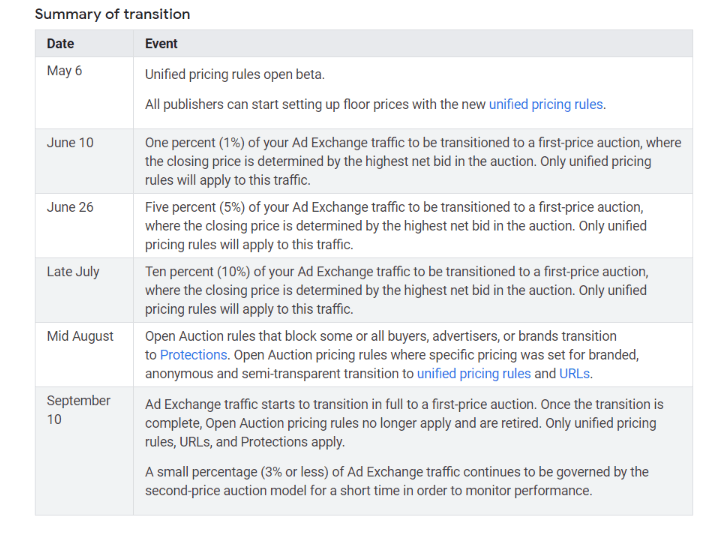
Google Transition Timeline
From Google itself, dates in 2019:
Sources
- https://digiday.com/media/what-is-a-unified-ad-auction/
- https://digiday.com/media/buyers-welcome-auction-standardization-as-google-finally-goes-all-in-on-first-price/
- https://support.google.com/admanager/answer/9298211?hl=en
- https://marketingland.com/google-shares-details-on-how-first-price-auctions-in-google-ad-manager-will-work-260830
- https://www.blog.google/products/admanager/update-first-price-auctions-google-ad-manager/
- https://adexchanger.com/ad-exchange-news/googles-first-price-auction-switch-is-making-header-bidding-partners-win-more/
The successful warrior is the average man, with laser-like focus.
— Bruce Lee


 Simply Ad Tech