


What Is an Agency Trading Desk?
ATDs are centralized, service-based organizations that serve as managed service layers, typically on top of a licensed DSP and other audience buying technologies. They manage programmatic, bid-based media and audience buying. They work as an agency’s internal “center of excellence,” supporting agency teams wishing to tap into this new buying model on behalf of agency clients.
Agency trading desks have also been described as:
- A dynamic way to purchase audiences, allowing media to be purchased in real time rather than from pre-procured inventory.
- Takes search (an auction based model) and applies it to display media; in a real time fashion like a stock exchange.
- An audience-buying company.
- A platform that uses data and technology to help advertisers more effectively purchase audiences at scale across digital media.
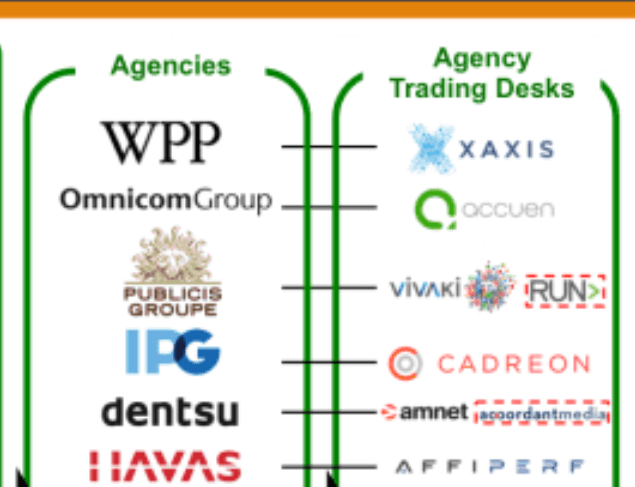
Below is a snapshot of the top 6 holding companies and their respective agency trading desks. Note that Vivaki was disbanded several years back and was recently replaced with Publicis Groupe’s new center of excellence, Precision.
What Are the Benefits of Working with ATDs?
[ Advertiser → Agency trading desk → DSP → Access to programmatic media ]
Representatives of agency trading desks position themselves as industry specialists. They hire staff with experience, run multiple campaigns for big clients and know how to manage advertising campaigns in various market segments. ATDs use their own data management platforms and ad servers to aggregate audience-based data, analyze it and draw valuable outputs for enhanced performance — a plus for marketers. Another benefit is gaining access to historical bidding data — optimization algorithms, bidding models and response prediction that can be used for repeated campaigns.
ATDs claim to handle every aspect of the marketing campaign so brands don’t need to worry about anything.
- More precise and better targeting
- Richer insights about performance on ad spend
- Better integrations and more consistent service. This holds true for ATDs of major holding companies, such as Xaxis or Cadreon
- Better ROI due to more precisely targeted ad spend
What Are the Drawbacks of Working with ATDs?
Troubles with agency trading desks first arose in 2012. Since then, a growing number of high-caliber brands have moved media buying in-house to reduce costs, increase transparency and gain more control over budgets. Some ATDs were originally tech enterprises offering unique services, while others simply outsourced most of the technology and paid for the third-party DSPs. In many cases, ATD clients were paying double fees.
Another point of criticism surrounding ATDs is they have a conflict of interest: An ATD is both the seller and the buyer simultaneously; therefore, it cannot be objective. “Trading desks must evolve or face extinction,” according to Digiday UK.
In 2014, an ANA and Forrester survey revealed that 42 percent of client-side marketers reported increased concerns over the levels of transparency between the client and agency. Top issues were media buying effectiveness, performance metrics, viewability, ad serving and billing. Some advertisers were paying up to 80 percent of their budget to the middleman, according to AudienceScience.
- Lack of transparency
- Double paying – once to the agency and once again to the trading desk
- Conflict of interest – ATDs act as the buyer and seller simultaneously
- Marked up media
- Mandates by agencies to only use their internal trading desks
- Operational challenges
Sources
- https://lumapartners.com/content/lumascapes/display-ad-tech-lumascape/
- https://adexchanger.com/Agency_Trading_White_Paper.pdf
- https://smartyads.com/blog/should-you-work-with-agency-trading-desks/
- https://targead.com/agency-trading-desk/
- https://www.mediapost.com/publications/article/294004/agency-trading-desks-still-dominate-programmatic.html
Technology is nothing. What’s important is that you have a faith in people, that they’re basically good and smart, and if you give them tools, they’ll do wonderful things with them.
— Steve Jobs


 Simply Ad Tech